Close
You have no items in your shopping cart.
Search
RSS

Blog posts of '2026' 'October'

How Smart Lighting Systems Communicate: Wi-Fi, Bluetooth Mesh & Gateways Explained

When you tap your phone, does your light instantly become cozy and warm? It’s like magic! But in reality, your smart lights are communicating with your router, phone, and other devices.

And when that connection is not working properly, your lights will either stop responding due to a delay or even fail to connect. Knowing how smart lights communicate can help you set them up properly in your home.

Why It Matters

Smart homes are becoming more popular in Malaysia. Many homes are beginning to install smart lighting systems.

Despite that, the increased use of smart lighting has brought about issues such as lack of responsiveness, connectivity issues, and complex apps. In many instances, the cause of the problem is not the lighting system itself but rather its communication system.

Understanding how smart lights communicate will enable you to avoid any compatibility issues and make it easier to install a smart home.

1. Smart lights need a "language" to listen to you

A smart bulb is like a normal bulb with a tiny computer inside. It needs a way to receive commands such as “turn on” or “dim to 30%.” This is called a communication protocol, or simply the “language” your smart devices use.

The most common types are Wi-Fi, Bluetooth, and Bluetooth Mesh. When you control a light from an app, your command is sent through one of these connections, and the light responds.

2. Wi-Fi lights connect straight to your router

Just like laptops and smartphones, smart lights with Wi-Fi can connect to the network of the home. They operate remotely via the internet and do not require any extra hubs. However, the performance of the router may be affected by too many Wi-Fi devices used at a time. For example, a house with 25 smart lights installed may have problems multiplexing devices while playing or streaming content.

3. Wi-Fi can get crowded in Malaysian homes

Most smart bulbs use 2.4 GHz Wi-Fi, which can get crowded in busy Kuala Lumpur condos. Thick concrete walls can also weaken the signal. For example, a bulb in an upstairs bedroom may keep disconnecting if the router is downstairs. This does not always mean the bulb is faulty. The problem may simply be a weak or unstable Wi-Fi connection.

4. Bluetooth is simple, but short-range

Basic Bluetooth connects your phone straight to the light, with no router needed. It is easy to set up and works even when the internet is down. The catch is range. Normal Bluetooth only works over a short distance, and it usually connects one phone to one device at a time. For example, a small studio apartment with two or three lights can work well with simple Bluetooth. But in a large home, you would have to walk close to each light to control it.

5. Bluetooth mesh lets lights help each other

Bluetooth mesh allows smart lights to pass messages from one light to another, helping commands reach devices farther away. Think of it like passing a note from person to person. In the case of semi-attached houses, for instance, the porch, living room, kitchen, and upstairs lighting can function in unison to broaden the reach of the signal. Moreover, Bluetooth Mesh can connect various devices at once.

6. Gateways connect your lights to the internet

Bluetooth mesh lights depend on a gateway to stay connected to the internet. This component connects to the router not only to facilitate communication between devices but also to allow the use of voice commands and scheduling when using Bluetooth mesh lights. For instance, one can switch on the porch lights while still at work using the smartphone since the gateway connects to the router. In this way, communication between Bluetooth mesh lights remains efficient and constant.

7. The best systems mix methods and plan for problems

There’s no single perfect setup for each home. Many smart lighting systems use Bluetooth Mesh for voice commands and remote access to their lights, including communication between the lights themselves. One must also consider what would happen if there is a power or internet outage. For instance, reliable lighting is important for a café located in Bangsar. Connection problems can be avoided by choosing the best configuration and gateway placement.

Conclusion

To function properly, smart lights require a variety of connection types. Wi-Fi works well for a small number of lights, Bluetooth is easy to use but has a short range, and Bluetooth Mesh connects lights over wider distances. Internet access and remote control are added by a gateway.

The best smart lighting system is not the one with the most features. It is the one that suits your home and works reliably every day.
Ready to upgrade your home?

Explore smart lighting solutions firsthand or get a Free Lighting Proposal Plan tailored to your exact floor plan by scheduling a visit to the Copper Connect Showroom! Our lighting experts will guide you in creating the ideal setup for your household. 


How to Choose the Right Lighting for an Open-Plan Living and Dining Area

Picture this: You move into a new home with an open-plan layout. The living room and dining area flow into one big, open space. It feels so airy! Then night comes, you switch on one bright overhead light, and the whole place feels like a hospital corridor. Sound familiar?

You are not alone. Many homeowners love open-plan spaces but find them tricky to light. The good news is that it is much easier than it looks. With a few simple ideas, one room can feel cosy for movie night and fresh for a family dinner. Here is what lighting experts have learned from years of designing open spaces.

Why Does It Matter?

In an open-plan home, no walls separate the sofa area from the dining table. Light does that job instead. Good lighting guides your eyes to where to relax and where to eat, even without a wall in between.

Lighting also changes how you feel. Harsh light after a long day at work can leave you tired and tense, while soft, warm light helps you slow down. On top of that, lighting affects your energy bills. Using smart, efficient LED lighting can help lower your power bill every month. So the right lights are not just about looks—they are about comfort, mood, and savings.

1. Think in Layers, Not One Big Light

The most common mistake is relying on a single light source. Good lighting usually includes three types: ambient lighting, the general light that fills the space; task lighting for activities such as reading or eating; and accent lighting to create atmosphere and depth. For example, consider ceiling fixtures, a pendant lamp above the dining table, and LED tape behind the TV.

2. Create "Zones" With Light

Since there are no walls, use light to mark each area's purpose. The dining table can have its own pendant light, while the sofa corner relies on a floor lamp or wall sconces. When hosting friends, you can brighten the dining zone; later, dim those lights and switch on the seating zone for casual conversation. Same room, two completely different moods.

3. Pick the Right Colour Temperature

The colour temperature of light is determined in terms of Kelvin (K), where the temperature ranges from warm white that is about 2700K–3000K, to cool white that is about 5000K–6500K. For the dining room and living room, it is advisable to go for warm white or neutral white that falls within the range of 3000K–4000K. Warm light in the dining area does make food appear attractive and appealing.

4. Choose Smart Lights You Can Dim

Dimmers and smart lighting give you complete control over open spaces. Smart bulbs allow you to control brightness and color from your phone or through voice commands. Instead of having to move around turning bulbs on and off manually, you can create customized schemes like “Movie Night” or “Dinner Party” and have the entire lighting system of your home automatically adjusted according to your choice.

5. Consider Climate and Ceiling Height

LED lights are energy-efficient and cooler than traditional light bulbs, resulting in less heat generation. You must also think about the ceiling height. If the ceilings are low to medium, you can mix slim recessed downlights with flush ceiling fixtures. Ceiling heights that are high allow you to decorate by choosing bigger pendants or other bigger light fixtures, which look good and aren’t too imposing for the interior.

6. Use Natural Light Wisely

If your room is heavily illuminated in the afternoon, take advantage of this natural light by using sheer curtains or blinds to minimize glare. When night comes, however, lighting should come in. Timed lighting can start to change when the sun is going down in order to keep the ambiance of the room comfortable.

7. Match Your Lights to Your Style and Furniture

Lighting acts as decor. A wooden dining table pairs naturally with warm woven or brass pendants, while a sleek modern sofa benefits from clean, minimalist fixtures. Keep a consistent style or finish across the open space—such as matching metal accents—so the room feels cohesive rather than fragmented.

Bringing it All Together 

It is not difficult to illuminate the combined living and dining area if you act in layers and design individual sections – choose warm colours, ensure that you can control the lighting easily, and pick your fixtures according to the size of the room. When all these elements are harmonized, the room will become a primary space, comfortable and stylish as well.

Every home is unique, and the ideal lighting scheme is the one based on your lifestyle and daily routine.

Ready to upgrade your home?

Explore smart lighting solutions firsthand or get a Free Lighting Proposal Plan tailored to your exact floor plan by scheduling a visit to the Copper Connect Showroom! Our lighting experts will guide you in creating the ideal setup for your household. 

Downlights vs Spotlights vs Track Lights: Which Is Right for Your Home?

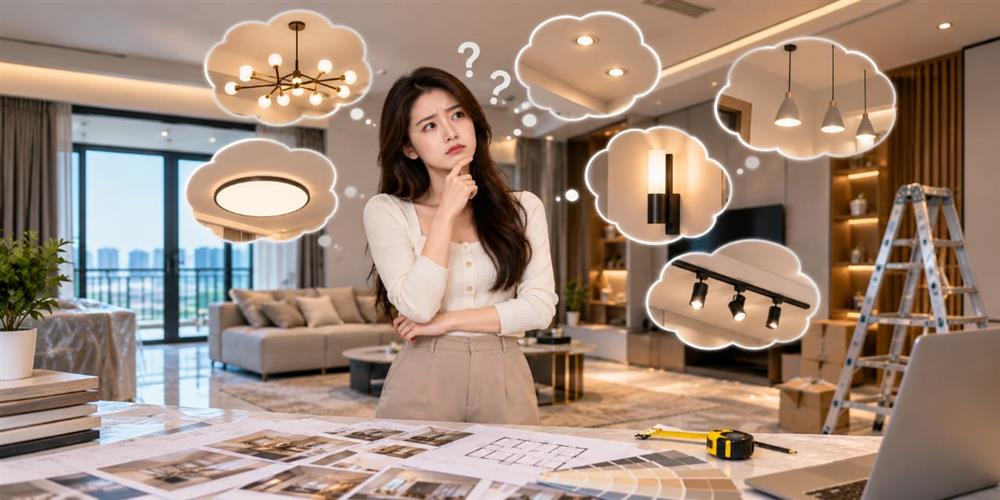
Picture this. You just finished renovating your new condo in Kuala Lumpur. The paint is fresh, the floor looks great, and the furniture has arrived. But when night comes, something feels off. The living room looks flat. The kitchen feels dim. The wall art you love disappears into the shadows.

Sound familiar? The problem is often the lights. Many Malaysian homeowners are not sure whether to pick downlights, spotlights, or track lights. This guide explains the difference in simple words, so you can choose with confidence.

Why This Matters

Lighting does more than brighten a room. It affects how your home looks and feels, as well as your eye comfort.

In Malaysia, where many homes have low ceilings and the weather is hot, choosing the right lights helps create a comfortable space while reducing electricity costs.

At Yeelight Malaysia, we’ve seen homeowners redo their lighting because of poor planning. Planning can save you time, money, and stress.

7 Key Points to Help You Choose

1. Know what each light does

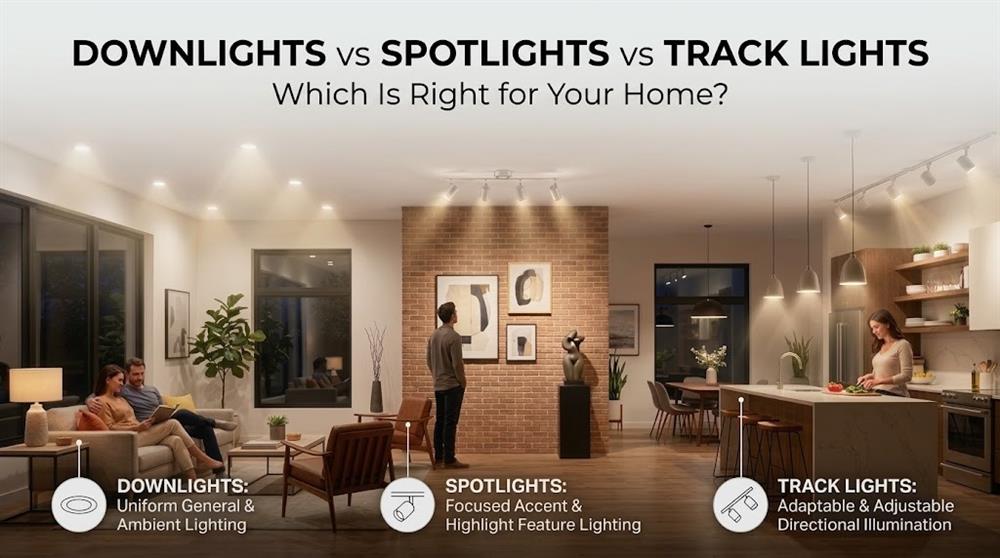
Downlights give a room soft, uniform lighting, while spotlights create focused light beams on art, decor, or a feature wall. By contrast, track lights can be slid along the track to point light in the proper area.

One should keep in mind that downlights are the main light elements, while spotlights act as accents and track lights are flexible lights. As an example, downlights could be used as the main light in the living room, while spotlights can be used to highlight the artwork or an accent wall.

2. Check your ceiling first

Downlights require space above the ceiling board, making them ideal for homes with a false ceiling. If your home has a solid concrete ceiling where cutting holes is not possible, surface-mounted track lights are the best choice because they require no major renovation work.

3. Think about glare and comfort

Light that hits your eyes feels tiring. Spotlights can cause glare if they point the wrong way. Downlights with a deeper design or anti-glare cover are gentler on the eyes.

For example, one couple aimed spotlights near their bed and found them too bright at night. They switched to soft, warm downlights, and the room felt calm and cozy right away.

4. Match the light to the room

Choose lighting based on how you use each room. Kitchens need bright, even light, while living rooms work well with a mix of downlights and spotlights.

For study areas, use bright, focused light around your desk. Bedrooms are better with soft, warm lighting for a more relaxing feel.

5. Remember Malaysia’s heat and your bills

Choose energy-efficient LED lights to keep your home cool and lower your electricity bills. Unlike older halogen spotlights that generate a lot of heat, modern LEDs stay cool while using far less power.

Because halogen lights produce excess heat, they force your air conditioner to work much harder. Replacing old halogen bulbs with LED equivalents immediately reduces room temperature and cuts down your monthly energy costs.

6. Smart control makes any light better

Smart lighting lets you control lights with your phone or voice. Adjust brightness, change colours, and create different lighting scenes with ease. It works with track, spot, and downlights.

For movie nights, dim your lights with one tap. You can also switch off forgotten lights from your phone without leaving your bed.

7. Plan your budget and installation early

Plan your lighting early to save time and money. Downlights need internal wiring, so plan them before the ceiling is finished. Adding track lights and spotlights afterwards for the purpose of illuminating specific areas is easier. 

When hiring an electrician, ensure that the electrician is qualified and that the products used are certified. Uncertified and cheap lighting is prone to flickering or risks of fire. 

Bringing it All Together 

There is no single winner here. Downlights deliver clean, even light. Spotlights are perfect for highlighting what you love. Track lights let you change things as your home grows. Most Malaysian homes look best with a smart mix of two or even all three.

Before you buy, think about your ceiling, your rooms, your daily habits, and your budget. Do this, and your home will look better, feel better, and cost less to run.

Ready to upgrade your home?

Explore smart lighting solutions firsthand or get a Free Lighting Proposal Plan tailored to your exact floor plan by scheduling a visit to the Copper Connect Showroom! Our lighting experts will guide you in creating the ideal setup for your household. 

How to Avoid Overlighting Your Home: Common Lighting Mistakes and Better Alternatives

If you visit a Malaysian home at night, almost all of the lights are on. It looks neat and airy, but is it always better to have more light? Not at all. A room with too much light can feel harsh, irritate the eyes, and consume more energy.

The solution is not to keep your home dark. Instead, make use of the right amount of light at the right time and place. These are some common overlighting mistakes and simple solutions.


Why It Matters

Lighting does more than help us see. It can influence a room's comfort level, how it's used, and energy consumption. Comfort is essential in view of Malaysia´s hot climate

Energy consumption can become too high when light sources are overused while the air conditioning is on. A good lighting scheme in a room should provide sufficient brightness but still ensure comfort and warmth of the space.


1. Putting Too Many Downlights in One Room

While downlights are common in Malaysian homes, too many of them can create glare and give the impression that a ceiling is crowded. Instead, use fewer downlights and add a floor lamp, wall light, or LED strip if needed. Consequently, the space becomes cosier and softer.

2. Choosing Lights That Are Too Bright

Often, buyers of bulbs consider bright lights to be the best. However, it is important to understand that every area has its own needs for illumination.

For instance, a bedroom's illumination should be less than a kitchen's. An ideal option for this room would be soft lights or dimmers, thus making it cozier and calmer in the evening.

3. Using Cool White Light Everywhere

The ideal lighting for work and study areas is cool white light, with a temperature of 6500K. However, homes may look too cold with white light.

Warm white light (2700K-3000K) provides a warm and soft atmosphere in dining rooms. If you use smart lighting, you can decide what light temperature to use according to various activities and times of day.

4. Lighting Everything at the Same Time

Another frequent error is switching on all lights when light is needed only in one place. For instance, when sitting on the couch and reading, there is no need to switch on every ceiling light. Instead, it is necessary to apply layered lighting like basic lighting, task lighting, or accent lighting, so that only the needed light is used while having something nice to look at in the room.

5. Forgetting About Natural Light

Malaysia gets plenty of sunlight, with apartments and houses still using artificial lighting in the daytime. This is because a room may become darker because of thick curtains, dark walls, and furniture blocking windows. Pull back your curtains and use light-colored furnishings to maximize natural light. Only use artificial lighting when natural light is insufficient.

6. Leaving Lights On When Nobody Is Home

It is easy to forget to switch off the lights when leaving home. Over time, this can lead to unnecessary energy use. You can schedule lights, operate them from your phone, or turn them off automatically with smart lighting. This makes controlling the lighting in your house simpler.

7. Ignoring Dimming and Smart Controls

Treating lights as just on or off is a frequent error. Different brightness levels are required for different activities. For example, you may want bright lights when cleaning and softer lights for dinner or movie nights.


Bringing It All Together

Many of us think that brighter means better, but a well-lit home is about using the right light, in the right place, at the right time.

Using fewer lights, softer colours, natural daylight, and smart controls can make your home more comfortable and help reduce energy use.

When planning your lighting, think about how you use each room. The right lighting choices can make a big difference to how your home feels.


Ready to upgrade your home?

Explore smart lighting solutions firsthand or get a Free Lighting Proposal Plan tailored to your exact floor plan by scheduling a visit to the Copper Connect Showroom! Our lighting experts will guide you in creating the ideal setup for your household.