
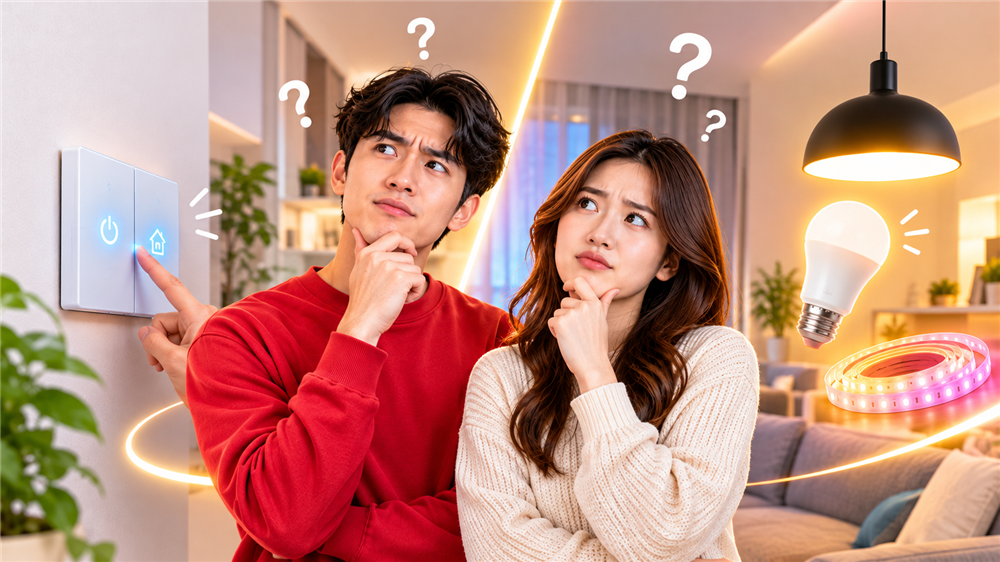
You walk into your living room after a long day in Kuala Lumpur traffic. You say, "Turn on the lights," and they glow softly. No fumbling for the wall switch. Nice, right?
More Malaysian homes are going smart these days. But when people start shopping, they hit the same question: should I buy smart switches or smart lights? Both sound great. Both promise a smarter home. But they work very differently.
Why This Matters
Picking the wrong one can waste money and cause headaches. Imagine paying for ten smart bulbs, then finding out your family keeps flipping the wall switch and cutting their power. Or imagine paying for an electrician to install switches in a home you rent, then having to leave them behind.
Malaysian homes are also a little special. We have condos with tight wiring, older terrace houses, big landed homes with many downlights, and a warm, humid climate that is tough on electronics. A choice that works in another country may not work the same here. So it helps to understand the basics first.
1. Cost: Think About Your Whole Home
Smart lights are cheap to start with. You buy one bulb, try it, and enjoy it. But the cost adds up fast if you have many lights. Smart switches cost more each, yet one switch can control a whole row of lights.
For example, picture a living room with eight downlights on one switch. Eight smart bulbs would cost much more than one smart switch. But for a single reading lamp in a bedroom, one smart bulb is the cheaper, simpler choice.
2. Installation: Screw In or Wire Up?
Smart bulbs are easy. You screw them in, open the app, and you are done in minutes. Smart switches go inside the wall. That means turning off the power and working with wires, so a licensed electrician should do it for safety.
For example, a young couple in a Petaling Jaya condo can set up smart bulbs on a Saturday afternoon. A family building a new home in Johor, on the other hand, can ask the electrician to fit smart switches while the walls are still open. That is the easiest time to do it.
3. Colours and Moods
This is where smart lights shine. Many smart bulbs and light strips can change colour and brightness. You can pick warm white for dinner, cool white for studying, or soft purple for movie night. A plain smart switch cannot do that. It only turns lights on and off, and sometimes dims them.
For example, a parent can set the kids' room to a calm, warm glow at bedtime. Try doing that with a wall switch alone, and you will be disappointed.
4. The "Someone Flipped the Wall Switch" Problem
Here is a problem many people only find out later. A smart bulb needs power to stay smart. If someone turns off the wall switch, the bulb goes offline. Your app and voice commands stop working until the switch is turned back on.
In a home with kids, helpers, or guests, this happens a lot. Smart switches fix this because the wall switch itself is the smart part. People can press it like normal, and it still works with the app.
5. Renting vs Owning
If you rent, smart lights are usually the better pick. You can take the bulbs with you when you move out. Changing wall switches is a bigger job, and many landlords will not like it.
For example, a student renting a room near a Kuala Lumpur university can simply screw in a smart bulb and enjoy a smart room. If you own your home and plan to stay for years, smart switches become a great long-term upgrade.
6. Types of Lights and Fixtures
Not every light in your home is a simple bulb. Some Malaysian homes have fancy chandeliers, built-in ceiling lights, or fans with lights. Some fittings do not take smart bulbs well, or the bulbs are hard to find.
Smart switches work well for these. They control the circuit, so the type of bulb does not matter much. For instance, a home with many fixed LED panel lights in the ceiling is often a better match for smart switches. A home with lamps and screw-in bulbs is perfect for smart lights.
7. Room to Grow
The best smart homes often use both. Smart switches handle the main ceiling lights. Smart lights add colour and fun in the places that matter, like the TV corner or a study desk. Most good brands also work with popular voice assistants and let you set scenes, like "Good Night," which turns everything off at once.
For example, a family can use smart switches for the whole house and add a light strip behind the TV. Later, they can link everything into one scene. Start small, then build up as you go.
Conclusion
So, which is better? The honest answer is: it depends on your home.
Choose smart lights if you rent, want colour, or just want to try things out cheaply. Choose smart switches if you own your home, have many lights on one circuit, or live with people who love flipping the wall switch. And if you want the best of both worlds, mix them.